Floating in the Dead Sea: A Unique Jordan Experience
Have you ever wondered what it feels like to float without trying? What if you could lie back in water and not sink? No kicking. No balancing. No effort at all.
You lean back, and the earth holds you. That’s the first strange promise of the Dead Sea. And when you finally step into it, somewhere in Jordan, you realize this isn’t a travel gimmick. It’s real. Completely real.
People talk about it like it’s a bucket-list thing. A photo opportunity. A novelty. But floating here feels different. Slower. Heavier somehow, yet lighter too. You arrive curious. You leave changed.
Science Behind the Float
At first, your brain argues with your body. Water is supposed to let you sink. That’s the rule. You’ve known it since childhood. But the Dead Sea breaks that rule.
The salt concentration here is nearly ten times that of normal ocean water. It’s dense. Thick. Almost silky. When you step in, the water resists you slightly, like it has substance. Like it’s thinking about whether to let you in.
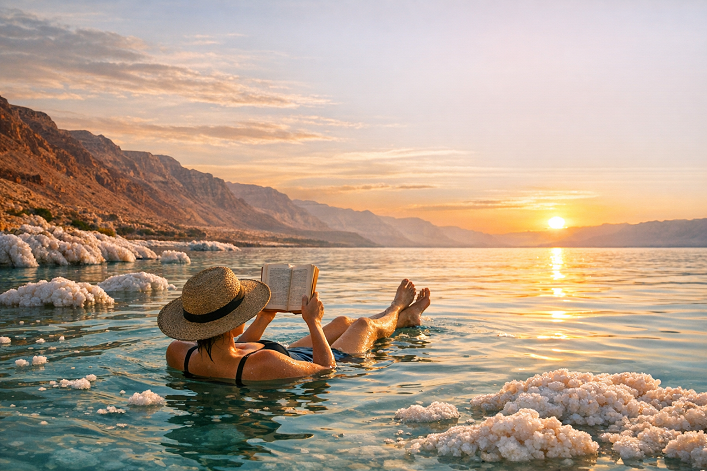
You bend your knees. Sit back slowly. And then it happens. You pop up. Not dramatically. Not violently. Just gently lifted. Suspended in a way that feels unnatural but also perfectly safe. You can stretch your arms wide. Raise your legs. You don’t have to tread water. You don’t even have to try.
It’s science, yes density and buoyancy and minerals. But in the moment, it feels like magic. You laugh. Most people do.
A Landscape Unlike Anywhere Else
The drive down feels symbolic. The road literally descends, winding lower and lower until your ears pop slightly from the pressure change. You’re going somewhere extreme. The lowest point on Earth. More than 400 meters below sea level.
The mountains around the Dead Sea are bare. Rugged. Painted in layers of beige, gold, and soft pink. Nothing lush. Nothing dramatic in the usual sense.
And yet it’s breathtaking.
The shoreline glitters with salt crystals. The water looks calm. Almost metallic in certain light. No waves crashing. No seagulls screaming. Just stillness.
You stand there and think, this shouldn’t look this quiet. This ancient. It feels biblical. Timeless. A place where stories began. And maybe they did.
Ritual of the Mineral Mud
Before you float, someone hands you mud. Dark. Thick. Silky between your fingers. “Cover yourself,” they say.
You hesitate for half a second, then give in. Arms first. Then legs. Some people smear it across their faces, laughing. It looks ridiculous. It feels wonderful.
The mud is packed with magnesium, calcium, and potassium. Minerals that have drawn travelers for centuries. Cleopatra reportedly valued it. Ancient traders carried it away like treasure.
As it dries under the sun, it tightens your skin slightly. You stand there coated in earth, looking like a sculpture half-finished. Then you step back into the water and rinse it away. Your skin feels impossibly smooth. It’s messy. It’s primal. It’s oddly luxurious.
Wellness, Relaxation, and Reflection
The Dead Sea has a rhythm. Slow. Intentional. Resorts along the shoreline offer infinity pools that blur into the horizon, spa treatments using local salts, and terraces where you can sip tea and watch the water shimmer.
But even if you aren’t in a resort, the atmosphere does something to you. The air pressure here is higher because of the low elevation. Some say it makes breathing easier. Sunlight filters through a thicker atmosphere, softening its edge.
You feel heavy and light at the same time. Time stretches. This is why a Dead Sea Day Trip fits so naturally into a Jordan journey. Not because it’s flashy. But because it forces you to pause. And we don’t pause enough.
Accessibility and Day Trips
One of the best things about the Dead Sea is how close it is to Amman. You can wake up in the capital, drink coffee overlooking city streets, and within an hour be descending toward this surreal shoreline. The transition feels dramatic—urban noise to desert silence.
Many travelers choose a Dead Sea tour from Amman, especially if they are short on time. It’s efficient. Easy. Almost effortless.
If you’re following a Jordan travel itinerary for 7 days, the Dead Sea becomes a perfect reset point. After Petra’s hikes. Before Wadi Rum’s dunes. Or maybe at the very end, when your body needs rest. It doesn’t require complicated logistics. It just requires showing up.
Best Time to Visit the Dead Sea
When discussing the Best time to visit Jordan, you have to remember that the Dead Sea lives by its own rules. Because it sits so low, temperatures here run warmer than much of the country. Even winter feels mild compared to northern cities.
Spring, from March to May, is ideal. Warm sun. Clear skies. Comfortable evenings. Autumn, from September to November, offers a similar balance. Not too hot. Not too cool.
Summer? Intense. Temperatures can climb above 40°C. The heat wraps around you like a blanket you didn’t ask for. Floating is still possible, but early mornings or late afternoons are kinder. Winter remains surprisingly pleasant. Cool breeze. Gentle light. There isn’t a bad time, exactly. But there are better moments.
Safety and Practical Considerations
Floating looks simple. It mostly is. But the salt here is serious. Don’t shave the same day. Even the smallest cut will sting in ways you didn’t imagine. Keep your hands away from your eyes. Salt in the eye burns sharply. Briefly. But sharply.
Enter the water slowly. Sit back gently. Never dive. This is not the place for cannonballs. Rinse off afterward with fresh water. Thoroughly. These small Jordan travel tips matter. They protect the magic of the experience. Because discomfort distracts. Preparation enhances.
Dead Sea in History and Culture
The Dead Sea has always been more than water. Ancient trade routes passed nearby. Civilizations rose and fell around it. Religious texts reference its shores. Caves near the region revealed the Dead Sea Scrolls manuscripts that reshaped historical understanding.
Kings and queens valued its minerals. Empires fought for the surrounding land. Standing there now, you feel layered in history and not overwhelmed by it. Just aware. You’re floating where people have stood for thousands of years. That’s not ordinary.
Combining the Dead Sea with Other Jordan Highlights
Jordan’s magic lies in contrast. One day, you’re walking through the rose-colored corridors of Petra. Next, you’re bouncing across dunes in Wadi Rum. Then suddenly, you’re lying flat on water that refuses to let you sink.
Few countries compress such diversity into short distances. The Dead Sea becomes the pause between adventures—the breath between sentences. You don’t hike here. You don’t rush. You surrender. And in that surrender, something resets inside you.
Sunrise and Sunset at the Lowest Point on Earth
If you wake early, before others stir, the shoreline feels sacred. The water turns silver under morning light. The mountains glow faintly pink. The air is cooler. Cleaner.
You step in gently. Float as the sun rises above the hills. At sunset, everything changes again. Orange melts into purple—the horizon blurs. Reflections sharpen.
There’s something poetic about floating below sea level while watching the sky burn above you. It feels like being in between worlds.
Environmental Awareness and Sustainability
The Dead Sea is shrinking. Slowly. Noticeably. Water diversion from the Jordan River, mineral extraction, and climate factors have reduced its size over the decades. Sinkholes appear along certain shorelines. Nature is adjusting, not always gently.
Visiting matters responsibly. Stay in designated areas. Avoid littering. Support local initiatives working to protect this fragile ecosystem because this place is rare. And rare things require care.
Why the Dead Sea Experience Stays With You
It sounds simple when you explain it later. “I floated in the Dead Sea.” But that sentence doesn’t capture the silence. Or the color of the sky. Or the strange feeling of surrender when you lean back and trust water that feels almost solid.
Travel often fills your schedule. Timelines. Tickets. Reservations. Here, you lie back and let go. For a few quiet minutes, you do nothing. And that nothing feels powerful.
Conclusion
Floating in the Dead Sea isn’t just about buoyancy. It’s about contrast. Desert and water. Weight and weightlessness. Ancient history and the present moment. It’s about stepping into a landscape that feels extreme yet calming. Stark yet beautiful.
You arrive curious. I may be skeptical. You leave softer somehow. Skin smoother, yes. But also mind quieter. In a world where most experiences demand energy, the Dead Sea asks for stillness. Lean back, it says. I’ve got you. And it does.
 Previous Post
 Next Post